

Published
- Bank
- Financing
- Tech
Financing networks too important to fail
Digital networks have quietly become the backbone of modern life. They connect mines deep underground, keep trains moving safely and help balance increasingly complex power grids. They also underpin emergency services, defence and countless everyday services that society cannot afford to lose.
In brief
The article in brief
- Digital connectivity is becoming critical infrastructure, underpinning mining, railways, power grids, emergency services and defence – increasing the need for secure, resilient networks.
- Modernisation requires major long-term investment. Ericsson’s Freddie Södergren points to ageing infrastructure, cyber threats and the transition towards 5G and 6G as key drivers.
- Mining, rail and energy are increasingly dependent on connectivity. Epiroc, Alstom and Hitachi Energy describe how digitalisation, automation and electrification are making reliable networks integral to their operations.
- Competitive financing is becoming part of the export offering. Swedish companies increasingly need attractive financing alongside technology and customer relationships to compete internationally.
- Early dialogue is essential, says EKN Director General Åke Nordlander, allowing exporters, banks and export credit agencies to develop financing structures that balance the needs and risks of all parties.
Critical connectivity requires long-term investment
As connectivity shifts from a useful enabler to mission-critical infrastructure, the requirements for resilience, security and reliability are growing – along with the investment needed to deliver them. Amid geopolitical uncertainty, cyber threats and increasingly contested global trade, the question is not only how to build networks that are too important to fail, but how to finance them.
That was the theme when EKN brought together the international export credit community with commercial banks and some of Sweden’s largest companies in Stockholm. Mining, rail and energy were represented by Epiroc, Alstom and Hitachi Energy, with Freddie Södergren, Head of Mission Critical Networks at Ericsson, as keynote speaker.
“Networks that are too important to fail are my focus. These are the most demanding use cases, in an environment where failure is not an option. Connectivity doesn’t just support the business; it becomes part of it, with resilience, security and trust becoming prime concerns. We take connectivity for granted, but it is fundamental to our everyday lives.”
Attractive financing attached to the offering is becoming increasingly important for us. We can no longer compete on technology and relationships alone.
Freddie Södergren, Head of Mission Critical Networks at Ericsson
That means networks are increasingly becoming part of society's critical infrastructure. Emergency services and first responders need communications that do not fail when lives are at stake; energy companies depend on connectivity to monitor and control critical infrastructure; and transport and defence systems increasingly rely on secure, resilient networks.
Ericsson networks carry around 50 per cent of the world's mobile traffic outside China, and the company operates in 175 markets. The next generation is already approaching.
“We are transforming connectivity. 6G is coming towards the end of the decade.”
For Södergren, the transformation also means replacing ageing infrastructure. Mobile systems built 30 years ago are approaching the end of their lives, while 2G and 3G are being phased out. At the same time, cyber threats are making security and redundancy ever more important.
“The backbone of connectivity, autonomy and latency demands for safe remote control requires modernisation of the digital backbone. Existing older networks are vulnerable to cyberattacks, so security is another driver – and a main reason for the leap. Redundancy is important too.”
From voice and text in the 1990s to high-bandwidth, low-latency connectivity today, mobile networks have evolved into platforms for real-time video, sensor data, AI analytics and advanced IoT. 5G can now deliver fibre-like performance over the air – making mobile connectivity increasingly critical to emergency services, industry and society.
The implications are being felt across industries.
5G and connectivity take mining underground
As the race for critical minerals accelerates, mining companies are going deeper in search of new deposits. Automated and remotely operated equipment depends on reliable, low-latency connectivity.
“You need to take the networks with you as you go deeper,” says Marcus Eklind, Global Product Portfolio Manager at Epiroc.
“The need for metals is increasing tremendously. The easily accessible ore bodies have been excavated, so we need to go a lot deeper, and connectivity is essential to ensure that automated, remotely operated equipment can function.”
“Finding finance is very important for us. This is a cash-intensive industry where you have to wait a long time before you get any money back.”
Marcus Eklind, Global Product Portfolio Manager at Epiroc
Epiroc and Ericsson have expanded their long-running partnership into a global agreement focused on LTE and 5G connectivity for underground and surface mines, supporting automation, digitalisation and remote operations.
The shift is changing the machines themselves.
“Physical equipment is becoming software-defined – historically, it was the other way around. With over-the-air updates, clients want the latest and greatest, which means we are becoming more and more dependent on digital infrastructure to operate.”
For mining companies, the investment challenge is considerable.
“Finding finance is very important for us. This is a cash-intensive industry where you have to wait a long time before you get any money back.”
Digital railways make connectivity a safety issue
Rail is another industry where connectivity is becoming integral to operations.
Maria Signal Martebo, Managing Director at Alstom Sweden, describes today's trains as a far cry from the steam locomotives of the past.
“Today’s trains are ‘software sausages’, with a lot of AI analytics used to monitor performance. Urbanisation is driving the need to transport more people safely and reliably, and railways are becoming much more digital.”
That makes reliable connectivity part of the safety equation – and financing part of the investment equation.
“Super-important. And increasingly so.”
Today’s trains are ‘software sausages’, with a lot of AI analytics used to monitor performance.
Maria Signal Martebo, Managing Director at Alstom Sweden
Her message to the export finance community is equally clear:
“Keep doing what you’re doing. Our HQ thinks the Swedish system is great and is eager for us to work with it. It is very easy to work with EKN and resolve issues along the way.”
Power grids need investment for the energy transition
The same combination of digitalisation and investment is reshaping power generation and transmission.
Magnus Callavik, Global Head of HVDC Engineering at Hitachi Energy, says the Swedish organisation has been hiring roughly one person a day for the past five years as demand grows.
“We have digitally monitored grids that are becoming increasingly electrified, driven by renewable power and increasingly local energy production. Countries need to interconnect all these local sources with the grid – and connect grids across borders.”
The scale of investment makes financing critical.
“There is a lot of cash to be raised, and we need our customers to help us finance capacity growth. They pay upfront with the help of export finance. We are right now signing deals for delivery in 2037. We do need support, in Europe too, given the investments required for the green transition.”
The digital layer itself needs continuous investment.
“The data-connectivity layer of the power networks needs to be replaced or upgraded continuously,” Callavik says.
Export finance becomes part of the offer
For Swedish exporters, the ability to offer competitive financing is increasingly becoming part of the competitive proposition alongside technology and customer relationships.
There is a lot of cash to be raised, and we need our customers to help us finance capacity growth.
Magnus Callavik, Global Head of HVDC Engineering at Hitachi Energy
“We are seen as trusted as a Swedish player, but it still needs to be as local as possible. We need a Team Sweden approach. Being trusted means different things in different markets, and we need to be perceived as domestic,” Södergren says.
“Attractive financing attached to the offering is becoming increasingly important for us. We can no longer compete on technology and relationships alone. We need to form a Western alternative together with Team Sweden.”
EKN Director General Åke Nordlander highlighted the scale of demand during his first year in office. EKN did deals in more than 130 countries and signed offers for SEK 390 billion in total guarantee volume – twice as much as ever before – with strong demand from defence, energy, mining and telecoms.
EKN's overall limit has also risen from SEK 450 billion two years ago to SEK 650 billion this year.
For Nordlander, the key to making the financing work is early engagement.
“Early dialogue is key. It is about arriving at a solution that fits everyone involved and takes into account the risks and challenges from all perspectives.”
That may be the central lesson from the mission-critical networks story. As digital infrastructure becomes increasingly critical to mines, railways, power grids, emergency services and defence – and to the wider functioning of society – the investment requirements are growing with it.
For exporters, banks and ECAs alike, financing is no longer simply supporting the technology. Increasingly, it is part of the infrastructure.
Major EKN-backed Ericsson 5G deals
The scale of the investment challenge is perhaps clearest in some of Ericsson's largest international projects backed by Swedish export finance.
In India, EKN backed financing equivalent to approximately US$2.1 billion in 2023 for Ericsson equipment for Reliance Jio's nationwide 5G rollout – EKN's largest-ever guarantee for a private company. The wider ECA-supported package, including Finnvera and Canada's EDC and equipment from Ericsson and Nokia, amounted to approximately US$3.8 billion. At the time, Jio was deploying a new 5G site roughly every ten seconds.
In Japan, EKN and SEK structured a JPY facility equivalent to US$584 million to finance Ericsson equipment for SoftBank's 5G rollout. The transaction was also the first project assessed under EKN's new Paris Alignment methodology.
And in Poland, EKN in 2026 backed a PLN 450 million 12-year local-currency facility for Play's nationwide 5G expansion, with Ericsson as a key technology supplier. The structure helps reduce Play's currency risk while supporting expansion into rural areas and smaller cities.
Together, the projects illustrate how export finance can help make large-scale network investment possible – while also supporting digital inclusion, technological resilience and the international competitiveness of Swedish suppliers.

- Financing
- Trends
- Trade
Record deal behind record-time 5G rollout in India
A $2.1bn export finance deal is powering India’s record-fast 5G rollout and accelerating nationwide digital inclusion.
Record deal behind record-time 5G rollout in India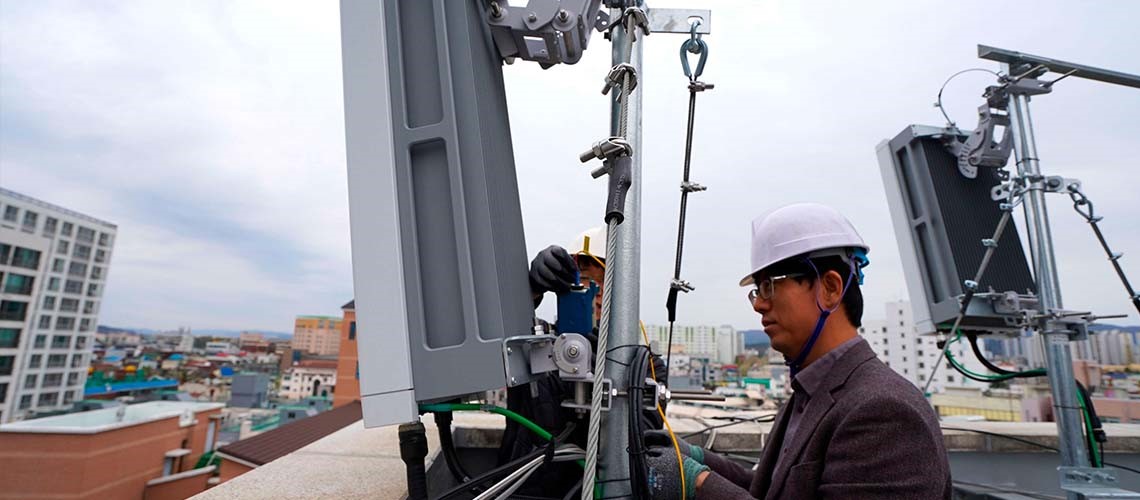
- Financing
- Guarantees
- Tech
Local currency cover from EKN secures major telecom deal in Japan
Local currency export finance helped secure a major 5G deal in Japan, reducing risk and enabling large-scale investment.
Local currency cover from EKN secures major telecom deal in Japan
- Financing
- Guarantees
- Digital
Long-term export credit backs a major 5G push in Poland
ECA-backed financing enables Polish operator Play to expand its 5G network nationwide, supporting faster connectivity and digital growth.
Long-term export credit backs a major 5G push in Poland