

Published
- Risk
- Trends
- Tech
Can global trade withstand the new era of uncertainty?
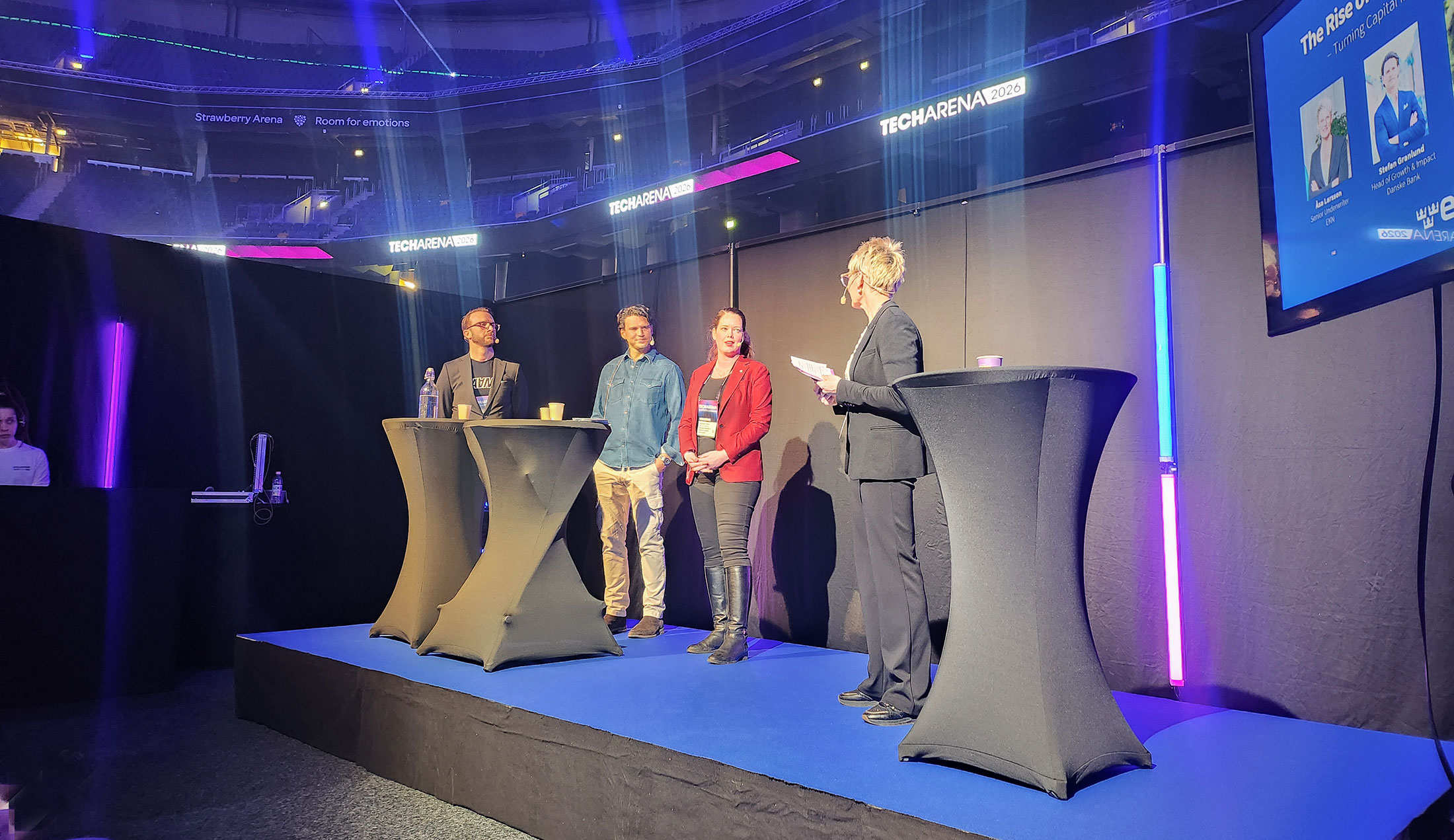
Will 2026 bring continued resilience in global trade, or are we entering a period defined by deeper structural uncertainty? At Techarena 2026, economic policy heavyweights convened under the theme “Markets in Motion: Navigating 2026 and Beyond” to assess the outlook for global trade, identify emerging growth sectors and weigh the risks ahead.
Economic policy leaders assess the outlook for trade, investment and geopolitical risk
To global markets, last year proved spectacularly eventful, with extreme volatility, geopolitical shocks and technological breakthroughs in AI. Still, world trade and Swedish exports showed remarkable resilience, according to Åke Nordlander, Director-General at EKN:
“For me, the big takeaway from 2025 is how well Swedish exporters handled the turbulence. They adapted so quickly — shifting markets, cutting costs — and their resilience truly impressed me.”
Annika Winsth, Chief Economist at Nordea, agreed that resilience is the right word:
“World trade increased despite tariffs and a generally bumpy road, which is very impressive. Swedish exporting companies were doing even better in the wake of a stronger krona, and I think the same will apply in 2026.”
Maximilian Freier, Secretary to the Monetary Policy Committee at the European Central Bank, concurred but cautioned against looming risks:
“I agree with the other speakers, but we should not overlook that we also have a lot of uncertainty coming from acute issues such as extreme policies in some countries, as well as the geopolitical challenges we face. Sometimes we get distracted from the underlying structural factors that are starting to play out and will keep us busy.”
He pointed to changing demographics, technological disruption and climate change as key examples.
“While we did see a lot of resilience last year, some of these acute and structural factors will keep us busy and maintain a high degree of uncertainty going forward.”
Global uncertainty shapes trade and investment decisions
Nordlander added that “the only real certainty in the global market is uncertainty, and that continues to shape how we navigate risk.”
“After meeting around a thousand SMEs last year, we finally saw cautious optimism return. But many companies are still holding back on important investments, and some have seen orders cancelled due to tariff threats. Since SMEs account for around 40 per cent of Sweden’s exports, this is a genuine concern.”
Navigating this environment means doing what EKN does best, he added:
“Reducing financial risk, enabling earlier access to capital, and supporting companies as they expand internationally. In 2026, smart risk-taking — backed by the right financial tools — will be key to managing global trade, geopolitical tensions and rapid technological change.”
The “new normal” demands innovation and flexibility
Mikael Damberg, former Minister for Finance and Economic Policy Spokesperson for the Swedish Social Democratic Party, advised companies to get used to “the new normal”:
“We live in a totally new world, and the old world won’t come back. I think the Nordics are in a strong position, as shown by the resilience of exporting companies and the strength of our tech scene. Innovation and technology beat everything else, and if you’re good at this you can take a market position and be successful.”
At Nordea, Winsth argued that “it’s wise to be humble and keep two thoughts in our minds at the same time.”
She meets companies that are juggling multiple scenarios simultaneously. AI is on the agenda for most of them.
“Corporate boards are eager for AI to be used in production as well.”
Freier noted that central banks were early adopters of AI in economic forecasting, but stressed the need for tangible productivity gains:
“We need to differentiate between deep and shallow AI adoption and secure massive productivity improvements, not just spell-checked emails. Still, I am much less concerned about AI now than I was a year ago, with broad-based adoption involving more actors.”
Energy and defence tech drive new export opportunities
Looking ahead, the panel identified several promising sectors.
“We’re seeing strong demand in both energy technology and defence-related technologies,” said Nordlander. “SMEs that used to focus on civilian solutions are now moving into dual-use applications, which opens up entirely new markets as European defence investment increases.”
As for Europe, the panel adopted a cautiously positive outlook.
“Growth will still be modest, but the euro area feels more stable than it did last year. Inflation is easing, confidence is improving, and Europe continues to attract capital because it offers stability and long-term investment programmes,” said Nordlander.
At the ECB, Freier warned that more action is needed:
“Only a fraction of the measures required to make Europe more competitive have been implemented. We are advocating the creation of a common capital market. We need to help companies make the right investment decisions for growth to really take off. European startups shouldn’t have to go to the US for funding.”
Still, “the EU investment fund helping companies scale up will be important,” Winsth suggested.
Asia and Latin America emerge as key growth markets
Looking beyond Europe, most experts see Asia and Latin America as the most promising regions.
“I’d say capital is moving more and more toward regions that combine strong demographics with stability — and yes, that puts a lot of attention on Asia. Countries such as India, Indonesia, Vietnam and the Philippines are growing rapidly, and China is shifting towards more consumption, innovation and automation.”
Nordlander also pointed to the challenges of entering new markets:
“You need investment and strong local partners. EKN can’t remove all the risk, but we can reduce it and make financing possible.”
New trade agreements with India and potentially with the Mercosur countries in South America could also open doors.
“It will be very interesting to see the results of the new free trade agreements, which may unlock huge markets such as Brazil, India and Argentina for European exporting companies,” Nordlander added.
The panel concluded on a positive note, especially regarding the Nordic region.
“The Nordics have a really good opportunity, along with Poland and the Baltic states,” Winsth said. “We have a lot in common and can serve as a role model or blueprint for the rest of Europe — we are innovative, we have access to risk capital and we are flexible.”
What about the risks ahead?
“The number one risk is still geopolitics,” Freier said, “not just ongoing conflicts but future flare-ups as well. Europe needs to take the integration steps we need in capital markets, deregulation, defence and structural reform. If we manage that, we may unlock massive potential.”
Related content
- Financing
- Tech
How SMEs and start-ups can succeed in defence tech
More SMEs and start-ups are entering defence tech – but regulation and limited capital still slow growth.
How SMEs and start-ups can succeed in defence tech
- Financing
- Tech
Let there be light – Swedish technology secures grid stability
The tech and financing behind stronger, more resilient power grids worldwide.
Let there be light – Swedish technology secures grid stability
- Financing
- Guarantees
Finno-Swedish ECA collaboration ready to take on bigger tickets
Finland and Sweden team up through Finnvera and EKN to support larger, multi-sourced projects with attractive financing.
Finno-Swedish ECA collaboration ready to take on bigger tickets
EKN World View – films
Short video stories from leading Swedish exporters and other experts. You can find more videos on EKN’s LinkedIn page.
EKN World View – films
EKN's guarantees
EKN's guarantees reduce the risk of payment defaults and help banks support businesses. Which guarantee suits your needs?
EKN's guarantees